Introduction
Launching a nutrition or health product requires much more than a good product idea.
Brands need to consider formulation, raw materials, production, packaging, quality control, documentation, and logistics. For companies that do not operate their own manufacturing facilities, working with an experienced OEM or ODM partner can provide a practical way to bring products to market.
What Is OEM Manufacturing?
OEM, or Original Equipment Manufacturing, generally means that a manufacturer produces a product according to specifications provided by the customer.
The customer may provide requirements such as:
- Product specifications
- Formula
- Packaging design
- Brand identity
- Quantity requirements
The manufacturing partner then produces the product according to the agreed specifications and processes.
What Is ODM Manufacturing?
ODM, or Original Design Manufacturing, provides a broader development service.
Instead of supplying only the manufacturing requirements, the customer may work with the manufacturer on:
- Product concept
- Formula development
- Product specifications
- Sampling
- Packaging
- Production
This can be particularly useful for brands that have a market idea but require technical and manufacturing support to develop the finished product.
OEM vs ODM
| OEM | ODM |
|---|---|
| Customer provides specifications | Manufacturer can support product development |
| Focus on manufacturing | Focus on development + manufacturing |
| Suitable for established formulas | Suitable for new product concepts |
| Customer-led product requirements | Joint product-development process |
The right model depends on the customer’s product development stage and technical requirements.
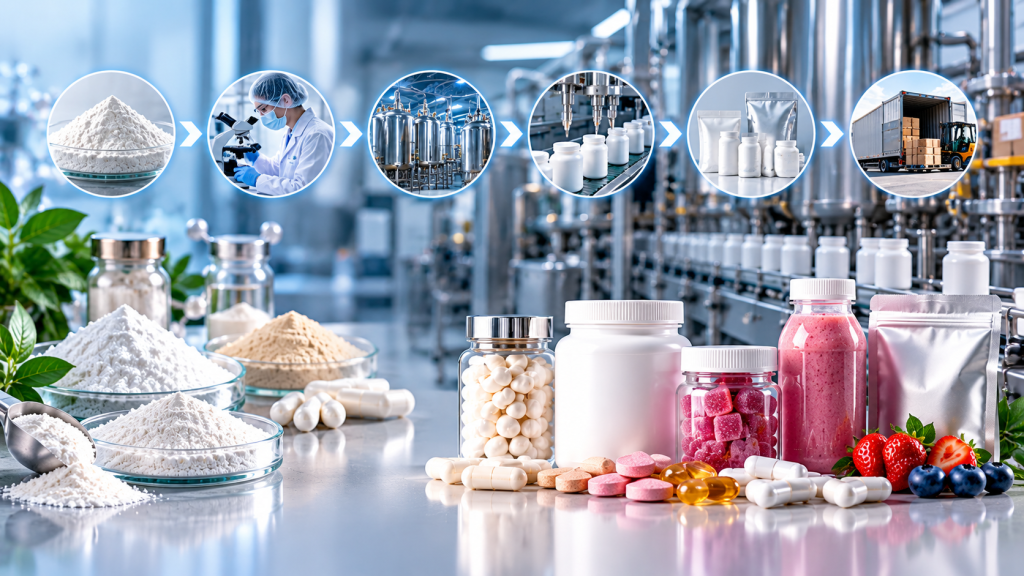
Typical OEM/ODM Process
Step 1 — Product Consultation
The project begins with a discussion about the product concept, target market, specifications, packaging, and expected production volume.
Step 2 — Product & Formula Development
The appropriate raw materials and product specifications are evaluated.
Step 3 — Sample Development
Samples can be developed for evaluation and adjustment before mass production.
Step 4 — Packaging
Packaging requirements, materials, labeling, and presentation are confirmed.
Step 5 — Production
Once the product is approved, manufacturing begins according to the agreed specifications.
Step 6 — Quality Control
The finished product undergoes the applicable quality-control and testing procedures.
Step 7 — Delivery
Products are prepared for shipment according to the agreed logistics and packaging requirements.
Why OEM/ODM Is Valuable for Brands
Working with an experienced manufacturing partner can help brands:
Reduce Manufacturing Complexity
Brands can focus on marketing and business development while the manufacturing partner manages production.
Accelerate Product Development
Professional technical and production resources can help move projects from concept toward finished products.
Support Customization
Products can be developed around specific market and brand requirements.
Scale Production
Manufacturing partners can provide production capabilities as demand grows.
OEM/ODM at Kunzheng Bio
Kunzheng Bio provides customized product cooperation and OEM/ODM manufacturing services.
The company’s service capabilities include:
- Raw-material supply
- Product customization
- Formula-related support
- Packaging customization
- OEM manufacturing
- ODM cooperation
- Brand collaboration
- Technical support
- After-sales follow-up
Building a Long-Term Manufacturing Partnership
A successful OEM/ODM project is not only about producing a product.
It requires:
Clear communication + Quality + Technical capability + Manufacturing capacity + Reliable delivery
A strong manufacturing partner can become an important part of a brand’s long-term product strategy.
Conclusion
OEM and ODM manufacturing provide flexible options for brands developing nutrition, health, and functional products.
By working with an experienced manufacturing partner, companies can access production capabilities, technical support, customization, and quality-management resources without building an entire manufacturing infrastructure themselves.